Wednesday, September 26, 2012

Canning, gardening and food storage

Summer is over.  I'd cry if I wasn't so tired of gardening and canning!  I wrote to a friend earlier this week that I've been praying for frost so I can quit with the garden but I was just kidding!


I've had amazing success with my garden this year and considering the dry weather this summer I feel truly blessed that it did so well - and most of it happened by accident.

We poured on the mulch all summer - load after load as we cleaned out the chicken coops.  In some places the mulch is now several inches deep and as a result I didn't water my garden all summer after the initial few days when the plants and seeds were put in.  I am as surprised as anyone that the garden was as lush as it was with no water. We did get minimal rain off and on - more than eastern Ontario for sure.  I am excited about the possibilities - one less chore to do in the hot summer and less stress on the well when things are already low.

I've read many people's accounts of moving to the country to take up gardening and raising livestock. With no prior experience the common theme is their oft repeated tales of woe and just how difficult it is to do what seems like something straightforward.  They are right - overwhelming-completely-totally RIGHT.  This is our third summer on the farm for those of you who are counting.  The first summer didn't count in the gardening-department  because we arrived in late June and didn't do anything except moan at the weeds and deal with settling in as a family.  I did spend some time getting the garden ready for the following year - after all I HAD gardened before and knew to some extent what was needed.  Last year's garden was better than I deserved for all the weeds and we did manage to dig out most of the tree stumps, overgrown perennials, rocks, old pots and garbage before the fall.

This spring as I've mentioned before we dumped load after load of manure on the garden and tilled it in.  I planted about half the total space knowing there were more tree stumps to dig out and shrubs to move in the other half.  Again I have been blessed beyond what I deserve in garden bounty.  

There are still beans producing out there and I wish for my conscience sake they would die because really-and-truly -I don't want any more!  I would give them away but the bean pods are bursting with beans and they don't look very appetizing. I planted two 45 foot rows of beans - that may have been a few too many!

The tomatoes are in the same category.  Oh MY - tomatoes everywhere.  I've been picking and canning them for weeks.  I still have several pails of green ones to deal with and I'm not sure what I will do with 100 quarts of green-tomato-whatever but waste-not-want-not.  I am going to try hanging some of the plants upside-down in the garage and see if they will ripen there.  My tomato cages were a complete and utter failure as I suspected they would be.  The patch was a jungle of vines and there was no way to pick without standing on some of the tomatoes no matter how carefully I walked. Next year I'm building wooden trellis' so the plants will hopefully grow UP instead of fall over.


My green pepper plants looked amazing - the leaves were shiny and green and healthy looking but production was not so great - I think because we added too much manure.  We got less than 1/4 of the peppers I was hoping for so we went to the pick-your-own pace nearby and picked 2 bushels to chop and freeze for the year.  My own would have been cheaper but considering the grocery store price of nearly a dollar each my two bushels with 70 - 80 peppers in each was a bargain at $41.00.  


Freezing peppers is my favorite way of preserving them.  It takes several hours of washing and chopping but for 40 bucks I won't buy another pepper for cooking for the year.  Someone asked if they could be used in salads - not the fresh kind as they come out of the freezer mushy but they are great for stir fries, casseroles or soup.  My Mom came over for coffee and she got drafted to help chop - thanks Mom!  Dehydration is another common way to store peppers but I am not as fond of them as frozen so in the freezer they went!

I didn't grow potatoes this year but I caught some really great sales at the grocery store a few weeks ago and I decided to can some.  Because they are low acid they require the pressure canner of course - aren't they pretty?  Wonderfully simple meals almost ready to eat!


Potatoes are best if stored in a cold cellar but we have not been able to figure out YET how to keep the basement cool enough for them to last - last year all the potatoes rotted in record time.  I've got a few ideas but I am running out of time - again!

A friend came for a quick visit yesterday to pick up her chicken order - hi Nina!  We chatted in the sunshine about healthy food and the effects of GMO on our food supply, backyard chickens, pesticide free gardens and free range eggs.  I was cooking up some turkeys to can and had another pot of tomatoes simmering on the stove to can later in the day while a basket of peppers muddied the floor.  I have three canners and various pots and pans and dirty dishes in the kitchen while the dining room table is covered with canning jars, baskets of squash, notebooks, cook books and my "canning bible".

Seriously - who lives like this??!  At a time when most people my age are looking at being empty nesters, decluttering and simplifying because it's just the two of them I've gone the other route completely!  I am making life MORE difficult and collecting equipment at an alarming rate.  I bought out the dollar store of canning lids the other night - 120 boxes...I'm sure some people think I'm crazy.

I am perfectly sane - most of the time.  So why am I doing this?  That is THE question.  There's more than one reason.  

http://www.grida.no/graphicslib/detail/monsanto-corporations-global-vegetable-seed-market-share_1075

That was in 2005!  Read this as well:  http://utopianist.com/2011/01/monsanto-now-owns-90-percent-of-the-worlds-transgenic-crops/ 

  • I'm concerned with our food supply and how it is being taken over by big companies who are more interested in money than what is good and healthy for us to eat.   http://www.cban.ca/Resources/Topics/Monsanto
  • "People are fed by the FOOD industry which pays no attention to HEALTH and are treated by the HEALTH industry that pays no attention to FOOD." Wendell Berry
  • I like knowing exactly what I'm eating - there are no pesticides, herbicides or GMO in the food I preserve myself because I don't spray and I use organic and heirloom seeds..
  • I am concerned about situations - once unheard of - all over the world where economies are failing and cutbacks are resulting in more and more people needing public assistance or who are eating out of dumpsters.  I think that many of us in developed nations can barely imagine that life could ever be like that here - I'm sure the people in Greece and Spain once thought so too.  http://www.cnbc.com/id/49162890
  • Our just-in-time delivery systems and long food chains from miles away are all just one crack from disaster.  Why are we eating apples from California when we grow them in Canada anyway???
  • I was a home schooling Mom for many years and the desire to learn has never gone away - call me a romantic fool emulating Laura Ingalls Wilder!
There are many reasons to be concerned - practically NONE of which I can do much about but taking care of my family as best I can by growing and preserving healthy fruits and vegetable and free range meats and eggs IS something I can do.  Some of you don't have room for a huge garden but you can support small farmers and buy locally grown, pesticide free produce, meat and eggs.  I challenge you to see what you can do to take some further steps to protecting your own food security.

I could think of many more reasons but I have to get back to canning the turkey and the great recipe I found for pickled green tomatoes!

So what are YOU gonna do about it?


Thursday, September 20, 2012

Food Storage: Packing pails for long term storage


As I've written many times before - I am a firm believer in food storage.  It's an insurance policy that covers one of life's most basic necessities - our daily food.

There have been many times in the past were we have had more-month-than-money and having food storage made life much easier.  It also allows for a quick meal when company comes unexpectedly or a helping hand when a friend is in need.

We have close friends who are going through a traumatic situation right now.  It has effected 
their finances and one of the biggest issues was money for food.  Even a small amount of food storage would have amounted to one less thing to worry about in the midst of crisis.

I see food storage as a multi-faceted or layered system.

I've written about having a large pantry - just extra of what you normally eat in the way of canned or boxed food right in your kitchen cupboards.  That's layer one.  

In my mind the next step or layer two is begin purchasing items on sale and keeping a supply of those items that exceeds what would fit into your kitchen cupboards by developing a secondary pantry - in our house it's called "Mom's Grocery Store".  These stores also include store bought products, frozen items and all the items I have been canning over the year.  Most shelf stable items have a 1 to 3 year best-before date and include things like peanut butter, canned soup and cereal. These are items that need to be rotated regularly and be things you eat on a regular basis.  Grocery stores have a FIFO system - it stands for First In - First Out.  In other words you need to put the new items at the back of the shelf and eat the older ones first.  More on that in a later post!

The third layer is long term storage.  There are some items that if properly packaged (and some not even properly packaged) have incredibly long storage lives.

Indefinite Storage Life Items:

Salt
Raw Honey
White Sugar

30 Year Items:

Hard Grains (Whole)
Corn
Flax Seeds
Kamut kernels
Millet
Wheat kernels
Spelt kernels
Oats (whole or rolled)
Rice
Beans and Lentils

and many more with differing storage life spans!

Maybe the first question is WHY you would want to store food for 30+ years.  This goes back to food insurance.  Any item you store should be something you already eat on a regular basis or something that should be introduced to your diet because you KNOW it's good for you.  If you can't eat wheat because you are allergic to gluten you will need to store something else of course and that's why lists of what to store are not always helpful - it will depend on your families needs.  

By preparing to store some of these foods you can essentially pack them and forget about them for a long time - kind of like the insurance policy on the house that you don't think about until you need it.  It could be used next year or 20 years from now with next to no nutrition lost.

The next question is HOW to store these items long term.  I took advantage of a great sale on rice and red lentils this summer and bought several bags of each so I could store them away for  the long term.  Rice and lentils will store for a very long time on the shelf or in your kitchen cupboard so this method just extends the life span by protecting it from three things.  Bugs, Oxygen and Moisture.

If you've ever had pantry moths - OH MY - you will know that some food items come from the store with bugs included. You don't actually see the bugs because they are more likely eggs at the point of purchase and flourish into armies of creepy crawlies in your cupboards.  To prevent or rather circumvent the bugs life - freeze everything.  This is a good idea for small bags of dried goods that you use on a daily basis too.  Freeze for three days and allow to come to room temperature before continuing.  


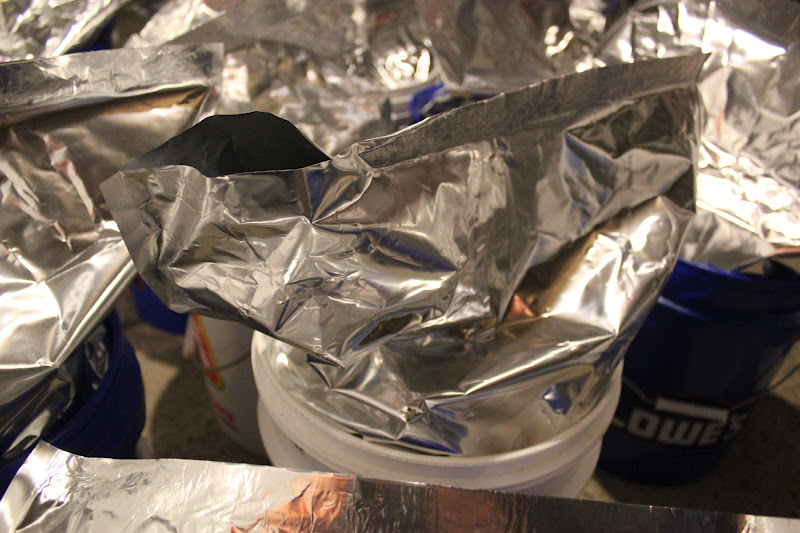
The next step is to accumulate some food grade buckets.  There are many articles written on which buckets are food grade and why this is important. I am using Home Depot buckets in the pictures above and there is some controversy about the food graded-ness (my word!) of the buckets so I wouldn't store food straight in the bucket.  Recycled buckets from a restaurant or bakery are usually a safe bet and sometimes you can get them for free.  The buckets main purpose is to protect the mylar bag from puncture and keep the product dry.  The pail on it's own is not enough to prevent oxygen from slowly degrading the food so a pail liner made of mylar is required.  The mylar bag used for this purpose is a thicker version of the mylar that those shiny birthday balloons are made of.  The most commonly available thickness is 5 mil.  They come in different sizes - a 5 gallon size that fits a 5 gallon pail is the most common but smaller sizes are available too which allows you to store multiple items in one bucket while keeping them separate.


The mylar bags are available from several online sources such as Briden Solutions.


While filling the pail shake the bucket or bang it gently on the floor to make sure all the nooks and crannies get filled.  Lentils don't bother me but some grains like wheat are dusty and aggravate my allergies so be sure to do it in a well ventilated place and if you are especially sensitive you might consider wearing a mask or at least taking an allergy pill before you begin!


Once the pail is filled close to the top - leave some room for the rest of the bag to fill the pail - you need to add oxygen absorbers.  These are also available online from the Briden Solutions. A 5 gallon pail generally requires approximately 1000cc. Something like rice has less air space while pasta would obviously have more so more O2 absorbers are needed. They are sold in different cc's but 500cc is common - so 2 per bucket or three if you're like me and want a little extra insurance.  I also use the shop vac to suck out as much air in the bag as I can before I close it up.  I forgot to take a picture of that step.


I usually do several pails at one time so I fill them all with the grains or beans or lentils and iron them  (using a board to press the iron against) most of the way shut - leaving a 4 inch gap.  Once all the buckets are at that point I go back and add oxygen absorbers as quickly as I can - this is where my kids come in handy.  The O2 absorbers begin to work as soon as you have them out of the package so you want them to be in the mylar bag and sealed up as quickly as possible - in about 20 minutes.  If you have extra absorbers and aren't going to use them all at once place them in a canning jar with a tight fitting lid or in a small mylar bag that has been sealed in the same manner as the large bags.  This will stop the absorbers from absorbing more oxygen than is in the jar.   A friend gave me a great idea - using a hair straightener to seal the pails.  I haven't been able to find one at a thrift store yet but it's on my list!


When I'm finished sealing the bags I let them sit for a day before I put the lids on the buckets just to be sure the O2 absorbers have pulled a good vacuum.  Don't forget to label the pails - before you close them up - or you may end up with mystery buckets that you'll have to open to figure out what's in them - ask me how I know :)  The great thing about mylar is you can carefully cut the sealed portion and reseal if necessary.


Now you just need a place to store them. An area with a fairly stable temperature like a basement or spare bedroom is ideal.  Keeping them in a garage or other outdoor area where the pails are exposed to high heat in the summer and then cold in the winter is not as good and will result in the contents not lasting the maximum amount of time and degrading the nutrient content.  The pails should also NOT be stored on a concrete floor where they could wick up moisture - even through the plastic pail.  Care should also be taken NOT to store them near chemicals that could eventually filter through the pail and compromise the air quality possibly (over a very long period of time) crossing the mylar barrier.  Those are pretty common sense tips - I wouldn't store my cereal beside a gasoline can either!

Although food stored this way can last for a very long time it is far better to store foods that you eat on a regular basis.  If you're going to store wheat then use wheat in your every day cooking and baking.  Learn to bake bread from scratch so if/when you DO need to use it you won't have the added stress of trying to figure out what to do with it. 

This is just one way to add to your families personal food insurance.  What did you do to add to your food storage insurance today?


Monday, August 20, 2012

Book Books everywhere

I am a self-confessed Book-A-Holic.  I could eat them for breakfast.  I love books.  I've always loved books and as a child spent many happy hours in far off places vicariously living an adventurous life.  It's the stories and the ideas and the imagination but it's also the feel of the shiny new cover and the pages still crisp with potential - almost impossible for me to resist.  DH knows that when my favourite magazine or a new book shows up in the mailbox I am suddenly ready for a cup of tea and a little sit-down.


I have books in every room of the house.  They are stacked in piles and loaded into baskets.  They grace the top of a long stretch of cabinets in the living room and adorn one end of the buffet.  They're in the bathroom - a little rumpled from the humidity while reading in the tub - they're in the car, under the bed - well - almost anywhere.


The subjects range from historical fiction - my favourite escape - to gardening, canning, farm animals, politics (those are DH's) prayer, home-schooling, counselling advice, Christmas decorating, organizational skills, herbs and foraging, renewable energy, website building (need to read those yet!) leadership, Do It Yourself type books... and more.


I love old cookbooks especially the ones that were compiled by church groups or organizations. Just reading them is a great study in the culture of the time it was written.  Any recipe that starts with 1lb of butter would probably not make it into a cook book in 2012!  I was tidying up today and most of what I put away was books. I may need an intervention soon!

Last winter when I had some time on my hands I started building a library - OK - it's actually a large-ish walk-in-closet.  I've got the plaster patching and the painting done.  The wallpaper is almost done - it's a most gorgeous cabbage rose flowered wallpaper that comes with a great story (for another time)  The hold-up is my lack of carpentry skills.  I am great swinging a hammer in the barn where my crude attempts to hit the nail aren't really on display for all the world to see - at least the animals haven't complained but I am not skilled enough to handle constructing the shelves I want.


I'm not even sure all the books will fit in there so I will be doing a selective de-cluttering when the books are ready to move in.

My love affair with the actual printed editions has made me quite sceptical of any digital reader.     How could it possibly compare to reading a REAL book.  I resisted for a really long time and still feel a bit like a traitor to my love but here is my full confession.

It all started with an email - maybe I shouldn't have read it.

The email contained a link to a page where you could download a FREE app for devices that allowed you to read books on your computer or tablet or even your phone. The  Kindle Reader App is available here.  It's free and simple to download.  It came with a few free books to get you started - most of which I didn't read but I did have a look to see how things worked.  I wasn't really impressed.  If I had to pay only slightly less for an e-book than for a REAL book I would pay the extra and get the REAL book every time.

There is one exception and it includes the word FREE.

Amazon has some FREE books - the selection changes every day - but since I have better things to do with my time than spend hours looking for them I wasn't really using my Kindle Reader very much until I bumped into another FREE website eReaderIQ.com.  I signed up and was able to choose the genres that where the most interesting to me and voila - they show up as an email every day.  I just click on the ones I want and download them straight to my Kindle app from Amazon.

I have downloaded books on gluten free baking and cooking, homesteading, gardening, canning, hydroponics, organic food, farm animals, historical fiction and lots more.  The convenience comes when you want to travel - I have taken baskets of books with me when I went camping and stuffed my luggage while travelling to the point of hurting myself.  Could I really go on vacation without a REAL book in my hands??  Probably not but this should cut down on the weight considerably.  


That's my helpful hint for the day!  Bet you'll love it!  


I've downloaded my freebies for today and I'm saving them for a camping trip that's coming up soon.  Now it's off to read a REAL book for a little while with a cup of tea!


Thursday, August 9, 2012

A few of my favourite things...Beautiful old kitchenware


My collection of flour sifters...

One of my favourite things to do on a Saturday morning is to head off to yard sales with my family.  A summer morning when it still a little bit cool with the promise of lots of heat by noon is the perfect kind of day.  Over the many years we've discovered the best places in the city to get the best deals.  When the kids were little we shopped for kids clothes and toys.  Now we've discovered new things to search for - or rather OLD things to search for.

My love of well worn antiques is nothing new.  My home is an eclectic mix of new, old and dragged-off-the-side-of-the-road or yard sale furniture and accessories.  I get a thrill of fixing something up that someone else considered trash.  A coat of paint sometimes or just re-purposing something makes it new to me!

My greatest love is kitchenware from back-in-the-day.  

Rolling pins and hand-cranked egg beaters...


Old jars re purposed to hold spices and tin measuring cups...


 Enamelware kitchen utensils and some butter pats for working the whey out of the freshly churned butter...


Biscuit cutters and tart pans...


A replacement of a set of measuring cups given to my by my next-door-granny as a child that stared this obsession with beautiful but functional kitchenware.  I dropped my original set as a young bride and cried many tears over it's loss.


A berry picker, an old fashioned wind-up alarm clock that I borrowed from my Mom in order to teach my son how to tell time - she never did get it back!


What is this fascination I have with these tools?  It reminds me of quilting bees and bake sales.  Of being given a set of measuring spoons embossed with the local hardware store logo as a gift for my hope chest from my granny - along with those measuring cups.  Canning and gardening and eating Granny's chilli sauce with roast and biscuits, drinking tea out of real china tea cups...all these things are things are treasured memories of being a child.  I enjoy having them around me as reminders every day of a life that seemed simpler and quieter - something to strive for when I get stressed out over the garden or the kids or life in general.

It's hard to drink tea from a tea cup in a hammock but you get the idea!

Quote taken from an old cookbook: "Thank God for tea!  What would the world be without tea?  How did we exist?  I am glad I was not born before tea!"  - Sydney Smith

Tuesday, August 7, 2012

Gardening Summer 2012

It's the middle of summer and I have hit the high-peak-allergy-time of the year for me.  Every year for about a month I am miserable despite all the natural and unnatural remedies I have tried.  I take more pills and swig down more apple cider vinegar in this month than the rest of the year combined which has the side effected of a very muddled brain and thus - my posting schedule drops off.

At the same time of course this is the busiest part of the summer with a full house in the barn and more ducklings and quail hatching each week and a garden that needs attention.  Yesterday we spent most of the day working in the garden which had been sadly neglected in the heat waves we've been having - think weeds 4 feet high in some places.  DH and I chopped and cut and mulched and it is looking much better.  I figure a few more hours on my part and I will be caught up - finally!  The picture below is what the "garden" looked like when we moved here two years ago.


The front garden - first year on the farm

The first summer I looked out the front windows at the total disaster of the previous owners garden and half-heartedly picked some weeds but mostly I just didn't have any time with moving and life situations at the time to do anything.  It was full of perennials planted willy-nilly, weed trees and a mess of stones, gravel and weeds.  I was able to move many of the perennials out and we chopped down and dug out many of the trees in the fall.

The garden - Second summer at the farm

Summer number two I started waaaaay too late and was stuck with a soaking wet garden that needed roto-tilling before I could even plant a thing.  A neighbour kindly came and tilled it for me but tilling with the wet conditions turned the garden into a concrete block when it dried out.  The few vegetables I did manage to plant struggled horribly and  produced better than I deserved but certainly not plentifully.  We watered most of the summer just to keep things alive which meant filling buckets from the cistern and carrying them to the garden.  Oh-JOY.


The garden - third summer at the farm

Year Three:  that would be this year.  Oh how spoiled I am!  I have a hose now - no more lugging buckets.  Early in the spring we added load after load of cattle manure left behind by our babysat winter cows. We've been adding top-mulch of any kind to the garden by the barrow full as we clean out the chicken and duck pens and finally things are looking up.  I planted a little less than half the garden space - the rest was still being green mulched (that's code for covered-in-weeds-that-I-didn't-have-time-to-pull)  I planted huge sections green beans, beets, carrots, peppers and tomatoes.  I decided to stick to basics. All of those are doing well - a bumper crop on all fronts but still not nearly enough for our family for a whole year which is my goal for the future.

It got me thinking about gardening for the long term as I pulled and planned. I've gardened in the past when we lived in town.  My gardens always looked respectable and produced relatively well.  In other words I am not a COMPLETE newbie and I still had a hard time.

Besides roto-tilling the wet garden I added manure that was not completely composted.  I may as well have bought a bag of weed seeds and sowed my garden with them.  That was a bad idea.  In the city I added cattle manure to my garden that came in a plastic bag from the garden centre - this stuff came from the poop pile in the barnyard.  Yeah - not the same thing at all!  I would guess it needs at least two years of composting before you use it.  Tomato bugs have invaded my patch and eaten plenty of the top leaves off the tomato plants.  I've been picking them by hand - shiver - they are as big as my middle finger and green - YUCK.


The garden - third summer at the farm

As I've mentioned before my garden is right smack in the middle of my front lawn for all-the-world-to-see.  I will admit to vanity - 4 foot tall weeds are embarrassing!  Someday soon it will look nice but it may be a few more years.  That however is not my main concern - getting the garden to a place where it produces useful amounts of food is my goal. Gardening takes time and effort and even with all the best ingredients and techniques you still do not control the weather or the bugs.  If gardening teaches us anything it's that we're NOT in control!

I read a post on one of my favorite forums lately about a young mom who with her husband had moved to their homestead about a year ago.  They were working their "be-hind-ies" off trying to get things done and she was concerned about getting the garden started and how DH wasn't getting to it (because he was building, digging, plowing etc.) or spending time with the two young children because he was so busy.  I felt sad for her.  I know the feeling.  There will always be too much to do - imagine how much more-so if your life depended on that garden!


The garden - third summer at the farm

I would tell her that YOU HAVE TO PRIORITIZE and slow down!.  I've had to prioritize.  I have written plans on pages and pages of things I want to do.  DH has his own priorities.  Some of them are simple, some require help from outside sources.  Some just require lots of time and there's still only 24 hours in a day.

My garden could have been bigger.  We could have had more animals.  We could have decided on no vacation this year. We could work from sun-up to sun-down.  We could stress and fret and worry about it.  We try not too.  I remind myself often that I am doing all I can do.  I still need breaks and even if a huge garden is ideal it is not ideal if I wear myself out trying to get it ready and take care of it.

So I simplify.  I grew less and learned more.  I had less animals but learned more about the ones I have.  I tried a few new things and did some old things better than last year and occasionally I grab a book and sit in the hammock and remind myself that this is the life I always wanted!


It's so beautiful and peaceful and perfect in it's own imperfect way.  Have I ever mentioned how much I love living in the country!!

Wednesday, July 25, 2012

Sweet little escapees...

Another beautiful summer day of chasing sheep!  Our baby lambs are growing quickly and becoming adventurous in their own right.  I've already told you about their roof-climbing-antics and that was bad enough.


They have apparently gotten to the age where they do not need to be Velcro-ed to their mothers side at all hours of the day - I'm sure the mom's are grateful!  Harriet and Nellie have spread their tiny hoofs and taken to finding every possible way to escape the paddock.  They've been climbing between the fence rails closest to the barn for a few weeks and up-till-now it's been really cute.  They would come out and eat some of the chicken scratch and scamper right back in to their freaked-out mothers who stood baaaaaaing on the other side of the fence.  Their older brother and favorite playmate Freddy is too big to fit through the fence so he has been left out of the fun.


Save me - my lambs won't give me a moments peace!

I think they got up yesterday just to test our patience!  The girls popped through the fence, hung out with chickens for awhile and then wandered much farther than they ever did before so we knew we had to put an end to it.  We broke out some leftover pallets and bungee corded them to the wooden fence - not very pretty but it worked.  All was well so back to the house I went.  Twenty minutes later - Moooooom.  They were out again - this time by climbing UNDER the welded wire fence to reach the grass beyond because we all know - the grass is ALWAYS greener...  One more pallet and an old cage to fill that hole and another that had potential and finally they stayed put...or maybe they are just waiting for today when I'm home alone to try again.


The mommas are looking a little less like they got run over by the lawn mower so I am just a tiny bit less embarrassed by their spectacular haircuts!  Mr. Sheepie is still sporting his winter coat - I feel so bad but I have not been able to get a hold of the sheep shearer and I am quite sure we would get injured trying to shear him ourselves. He hasn't been nearly as friendly since shearing the momma's - I think he knows eventually his turn will come.


A friend and little Miss Rosie came for a visit awhile back - she almost got a kiss!

We are still working out details of a possible trade with a sheep-farmer-friend.  We are really wanting to increase the size of our flock so we want to trade Freddy, Harriet and Nellie for some unrelated females.  It will be hard to say goodbye to the lambs but this farmer is growing up and starting to wear her big girl overalls!!

Sunday, July 22, 2012

Sumac Iced Tea for hot summer days!

It's been blazing hot here in Ontario as it has been in many areas of North America over the past few months.  We've been reasonable comfortable except for last weekend - even with every trick I could think of it was too hot to do much of anything that required exertion!

We forgo air conditioning at the farm because there is almost always a breeze.  Some of the ways we keep the house cool are pretty obvious to most frugal folks.  We open every window as soon as the sun is off the windows at night.  In the morning we close the windows and any blinds on the east side of the house, continuing to close windows as the sun come around to the south and west.  Most days that keeps it pretty comfy.  We invested in some extra fans this year and make good use of ceiling fans as well.  Basically if we can't keep it cool enough to work during the day we get up early to do chores and relax during the day until evening when we finish the necessities outside. 

In the same vein of keeping cool - I've been learning about Sumac Iced Tea.  We have plenty of sumac trees around and they are in many of the ditches on the nearby side roads.  Last week after a particularly brutally hot day my daughter and I went for a walk after sundown.  I feel cooped up when I can't get outside!  We picked some sumac berries to take home and started our tea.

Staghorn Sumac


I'm not sure it could be simpler!  I lightly rinsed off the berries and covered them with cold water in a glass pitcher with a lid.  I used three heads of berries but you can use more or less.


I left it on the counter to infuse overnight and woke up to a beautiful dark red juice.  I fished out the heads and ran the remaining juice through a coffee filter to strain out the tiny little hairs and bits. You could also use a coffee press or a clean cloth.


Then I added some stevia drops - but you could use the sweetener of your choice.  Some people think it tastes very lemony - like lemonade but personally I found it much milder.


Sumac tea is very high in vitamin C and for most people it's free for the taking right outside the door! Some sources say it has twice the vitamin C of oranges.  It makes a great refreshing hot weather drink!

You can learn more about Sumac Tea by reading here.

I borrowed the following from a Facebook friend.


IT'S SO HOT in Ontario or just about anywhere else in North America right now!


.....the birds have to use potholders to pull the worms out of the ground.
.....the trees are whistling for the dogs.
.....the best parking place is determined by shade instead of distance
.....hot water comes from both taps.
.....you can make sun tea instantly.
.....you learn that a seat belt buckle makes a pretty good branding iron.
.....the temperature drops below 90 F and you feel a little chilly.
.....you break into a sweat the instant you step outside at 5:30 A.M.
.....your biggest motorcycle wreck fear is, "What if I get knocked out and end up lying on the pavement and cook to death"?
......the potatoes cook underground, so all you have to do is pull one out and add butter.
.....the cows are giving evaporated milk.
.....farmers are feeding their chickens crushed ice to keep them from laying boiled eggs.


Do you have any tricks that help you stay cool?


Saturday, July 7, 2012

The Latest LDS Preparedness Manual -free download


In my prepping journey I have had some strange looks when I mention I am aiming for food storage for a year (I have a long way to go!)  Some people have asked if I've switched faiths and become Mormon - ah no.  I believe however they DO have the right idea when it comes to food storage and being prepared for emergencies - something that the Lord made very plain that I was supposed to do.  


Photo credit
Sometimes I feel like Noah - building my ark because I just know I must be obedient.  This is my favorite prepping verse: 


Proverbs 22:3 New Living Translation 
A prudent person foresees danger and takes precautions.
The simpleton goes blindly on and suffers the consequences.


It makes perfect sense to me that being prepared is a wise way to live.  From the simple glitches in finances due to unforeseen circumstances to weather related storms and the further out-there scenarios that some call TEOTWAWKI - The End Of The World As We Know It.  Anything that turns our worlds up-side-down is bound to be easier to handle if we have some preparations in place.


Since the Mormons were pioneers in the Food Storage & Preparedness idea I take their research on how to store foods seriously.  They have researched HOW to store foods most effectively and have laboratory data to back it up.  The other articles fall naturally in place when you look at WHY you should have food storage.


The author/compiler writes: This book is NOT an original work.  Rather, it is a compilation of many different author’s works that have been gathered from the public domain of the Internet over the course of many years. These articles have been bound together and are presented here to simplify your access to them.


This is a FREE 509 page download - LDS Preparedness Manual

I've read many of these articles over the years on their respective websites and blogs and have a good sense that these are people who know what they are talking about.  This is a very worthwhile download!  As the author/compiler writes in the forward:  this is NOT something to tuck away until something bad happens - this is how to get ready BEFORE something bad happens.

The contents are directed towards people who are LDS so there is some information about wards and leadership that don't apply to me so I just skip over it and carry on.


Here's a quick look at some of what this book contains:


Section 1: Emergency Preparedness. Why?
  • Normalcy Bias, It’s All in your Head, by Survivalmom
  • Understanding the Normalcy Bias Could Save Your Life, by Confab


  • The Five Principles of Preparedness, Phil Burns
  • Mental & Spiritual Preparations for Survival, by jc
  • How Long until You Starve?, by Mr. Yankee
  • General Preparedness Survey, by Christopher Parrett
  • Five Levels of Preparedness, by Suburbanprep

Section 2: Getting Started
  • LDS Church FAMILY HOME STORAGE KITS, by Christopher Parrett  
  • Food Storage, by Christopher Parrett  
  • BARE-MINIMUM Food Storage Requirements, by Christopher Parrett
  • Our Food Supply is Fragile, by Christopher Parrett
  • Do you Really have a Year’s Supply??, By Christopher Parrett


  • Food Storage Tools & References
  • Basic Food List, by Lynette B. Crockett
  • Long Term Master Food List, by Christopher Parrett
  • One Year Supply Guide, by Dealsonmeals
  • Monthly Food Storage Purchasing Calendar, by Andrea Chapman
  • 30 Day Emergency Food Supply, by by Robert Wayne Atkins
  • Real-World One-Year Emergency Food Supply , by by Robert Wayne Atkins
  • The Seven Major Mistakes in Food Storage, By Vickie Tate
  • Common Storage Foods, By Alan T. Hagan


  • Grains & Legumes
  • Grains and Flours, By Alan T. Hagan
  • Legume Varieties, By Alan T. Hagan
  • Availability of Grains & Legumes, By Alan T. Hagan
  • Moisture Content in Grains & Legumes, By Alan T. Hagan
  • Grains Cooking Chart
  • Basic Cooking Instructions for Grains & Legumes, by Zel Allen


  • Sugar, Milk Fats & Oils
  • Sugar, Honey and Sweeteners, By Alan T. Hagan
  • Dairy Products, By Alan T. Hagan
  • Canned Fluid Milks and Cremes, Butter, Cheese, Eggs, By Alan T. Hagan
  • Infant Formula, By Alan T. Hagan
  • Fats and Oils, By Alan T. Hagan


  • Cooking Essentials
  • Cooking Adjuncts, By Alan T. Hagan

  • Processing & Preservation
  • Storage Life of Dehydrated Food, By Al Durtschi
  • Shelf Life Studies, by by Robert Wayne Atkins, P.E.
  • Pros & Cons of Freeze-Dried, Dehydrated, MRE, etc, by Skipper Clark
  • MREs, Meal Ready to Eat, By Alan T. Hagan


  • Sprouting
  • Growing and Using Sprouts, by Al Durtschi
  • Survival Seeds, by suburbanprep
  • Seed List


  • Storage
  • Storage Containers, By Alan T. Hagan
  • LDS Church Plastic Buckets for Longer-Term Food
  • LDS Church Pouch Sealer Instructions
  • Oxygen Absorbers, By Alan T. Hagan
  • Moisture Control in Packing and Food Storage, By Alan T. Hagan
  • Spoilage, By Alan T. Hagan
  • Recommended Food Storage Times, By Alan T. Hagan
  • Space Cramp, Where do I Put it all?? by Kim Hicken

Section 3: Every Needful Thing
  • Get a Kit, Make a Plan, by Christopher Parrett
  • Building the right Bug Out Kit for you, by Westfalia
  • OK, But what do I prepare for?, by Capt. Dave
  • Survival Priorities” The Rule of Three, by Thesurvivalmom


  • 72 Hour Emergency Kit (Get Out Of Dodge / Bug Out Bag)
  • A High Mobility 72 Hour Kit, by Ward Dorrity
  • Tools for your Vehicle, by Ward Dorrity
  • Get Out Of Dodge / Bug Out Bag checklist, by Chris Parrett
  • The Supply Table: The Master Preparedness List, by Chris Parrett


  • Evacuation
  • The 3rd Wave, Evacuation From A Disaster Location, by ST
  • Bug Out Trigger Criteria, by Mr. Jones
  • Understanding Everyone In the City Will Be a Refugee Post SHTF, by Suburban


  • Communication
  • Communications Family Ready, by Amy Loveless
  • Radio Spectrum, by Brian S
  • LDS Emergency Communications, by Dennis Bartholomew
  • General Radio Primer, by Bidah
  • Basics of Radio Communication, by Brian S
  • Sample Stake Communications Plan, by Brian S.
  • Survival Communications Primer, by Vector Joe
  • Sample Family Emergency Communications Plan, by Brian S.


  • Financial
  • Money, Edited by Christopher Parrett
  • Setting up and Emergency Cash Stash, by RusherJim
  • Debt and Preparedness, by iprepared
  • Get out of debt while you can, by preppingtosurvive


  • Medical
  • Medical Kits for Self-Reliant Families, by Jackie Clay
  • TEOTWAWKI Medical Kits, by Survival and Austere Medicine
  • Seven Antibiotics to Stockpile and Why, by Cynthia J. Koelker, MD
  • Using Expired Medications, by Cynthia J. Koelker, MD


  • Defense
  •  Defense, Edited by Christopher Parrett
  • Selecting a Preparedness Battery of Firearms, by Sergeant


  • Heating, Cooking, Lighting
  • Survival Fire Safety, by Mr. F
  • Emergency Heating & Cooking, by Greg Pope
  • Emergency Lighting, by Robert Roskind & Brandon Mansfield
  • Emergency Electrical Lighting, by Robert Roskind & Brandon Mansfield
  • A Short Course on Batteries, by Brandon Mansfield
  • Off Grid Power, by Brian S
  • Electric Generators, By Steve Dunlop


  • Clothing
  • Clothing, Edited by Chris Parrett
  • Warm, Protected and Modest: What to Wear in Difficult Times, by Marilyn
  • Winter Clothes For Preparedness Survival, preparedness1
  • Clothing Checklist By Jessica
  • Washing clothing after TEOTWAWKI, by Kylene


  • Shelter
  • Emergency Shelter, by Larry Bethers


  • Sanitation
  • Emergency Sanitation, by Greg Pope.
  • Emergency Toilets & Garbage Disposal, by Alan T. Hagan
  • Emergency Sanitation – The Scoop on Poop, by Kylene
  • Controlling Odors, by Kylene
  • TEOTWAWKI smells bad, get used to it !!, by Suburban Prep


  • Testing your Preparedness
  • 3 Minutes without Breathing, by Mayo Foundation
  • 3 Hours without Shelter, by Jon Doran
  • 3 Days without Water, Bill Straka
  • Water, by Paxton Turner
  • 3 Weeks without Food By Ron Shirtz
  • Surviving in the City, Edited by Christopher Parrett


  • Babies and Small Children
  • Baby Gear for TEOTWAWKI, by Preppingtosurvive.com
  • Getting Children Involved in Preparing, by Preppingtosurvive.com
  • What Do You Tell the Children?, by Preppingtosurvive.com
  • Avoiding Fear, by Preppingtosurvive.com


  • PANDEMICS
  • Facts about Avian Influenza, US Government
  • Preparing for a Pandemic Outbreak (SIRQ) Plan, by Madison Hospital
  • Quarantine, Quarantine, Quarantine
  • Medical Quarantine Protecting Your Family from Infection, by Dr. Cynthia Koelker
  • Basic Pandemic Supply List
  • Isolation Room Setup


  • Terrorist Attack
  • National Security Emergencies, by National Terror Alert
  • What to do if Nuclear Disaster is Imminent, by Ki4U

Section 4: PREPAREDNESS OUTSIDE YOUR COMFORT ZONE
  • TEOTWAWKI, by “Survivinghealthy”
  • The Precepts of My Preparedness Philosophy, by James Rawles
  • On Sheep, Wolves and Sheepdogs, by LTC Dave Frossman
  • 100 Emergency Items: That Will Disappear First, by Tess Pennington
  • Some Ground Truth-The “Us” & the “Them” in a Societal Collapse, by RJ
  • Fears of a Prepper, by ST
  • Unprepared: Welcome to the Promissed Land, by Rod E.
  • I Am Your Worst Nightmare, by Dan at “Survival-spot.com”
  • The Thin Blue Line, by Deputy W.
  • The Overnighters: Coming to a Neighborhood Near You, by Frank C.
  • Why Prepare, when I can take it from the Mormons?, by Rambuff
  • Thoughts on Disaster Survival, post Katrina , By Anonymous
  • A Look Back At Katrina… An Expereinced Prepper Tells All, by Raptor
  • Lessons from Argentina’s economic collapse, By ferfal
  • A First-Hand Account of Long-Term “SHTF” Survival in Bosnia, by Selco
  • Society’s Five Stages of Economic Collapse, by “targetofopportunity.com”
  • EMP, Electromagnetic Pulse, by Tom S
  • MZBs:Are you prepared?, by “doomers.us”